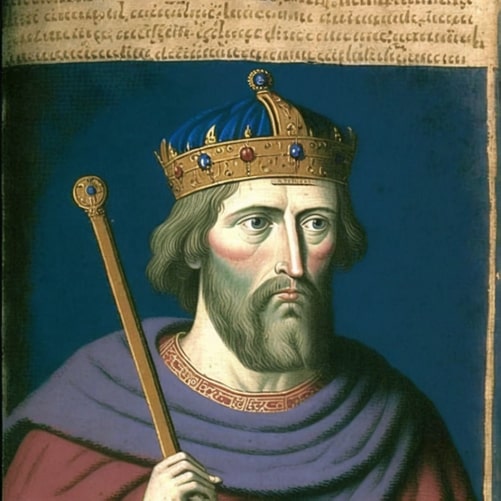
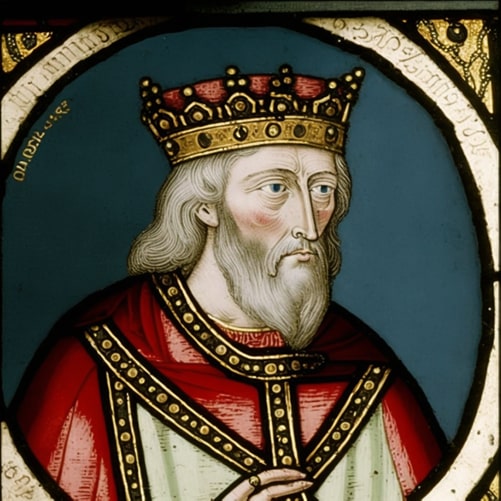
Aethelred / Ethelred the Unready


Aethelred / Ethelred the Unready
975 – 978 A.D
Explore the tumultuous reign of King Aethelred the Unready, marked by Viking raids and internal strife. His rule, from the St. Brice's Day massacre to his exile and return, highlights a period of significant challenges and transformations in medieval England, earning him his notable epithet.
Early Life and Background
Born circa 966, Aethelred was the second son of King Edgar the Peaceful and Queen Ælfthryth. His early years were shaped by the prosperous reign of his father and the subsequent upheaval following the assassination of his half-brother, Edward the Martyr. This backdrop of familial strife and political maneuvering in the court influenced Aethelred’s perceptions of kingship from a young age.
Ascension to Power
Aethelred ascended to the throne in 978, following the mysterious death of his half-brother, King Edward the Martyr. His succession at a young age placed him at the center of the kingdom’s political machinations. The early years of his reign were overseen by his mother and influential ealdormen, setting the tone for a kingship marked by significant challenges.
Rule and Reign
Aethelred’s reign, which extended from 978 to 1016, was one of the longest in Anglo-Saxon England. His reign was marked by recurrent Viking raids that tested the resilience of his kingdom. A critical and brutal moment came in 1002 with the St. Brice’s Day massacre, where Aethelred ordered the killing of all Danes in England in response to ongoing Viking threats. This act provoked further aggression from Danish forces, intensifying the conflict. His responses, often seen as inadequate or misinformed, earned him the moniker “the Unready.”
Challenges and Conflicts
The Viking threat culminated in repeated invasions, leading to Aethelred’s decision to pay the Danegeld, a tribute to deter Viking raids. His reign was further complicated by internal dissent and the struggle to maintain authority over his nobles. The St. Brice’s Day massacre remains a notably dark episode, reflecting the desperation and extreme measures resorted to during his rule.
Diplomatic and Cultural Contributions
Amidst his military struggles, Aethelred sought alliances, notably through his marriage to Emma of Normandy in 1002, which was aimed at securing support against the Vikings. His reign continued to foster the Church and monastic reforms, although overshadowed by the ongoing conflicts.
Legacy and Succession
Aethelred’s reign is remembered for its turbulent response to the Viking threat and internal strife. His forced exile to Normandy in 1013, following Sweyn Forkbeard’s invasion, was a significant low point. However, Aethelred’s return in 1014, after Sweyn’s death, allowed him to reclaim his throne, albeit briefly. His return and the continued resistance against the Vikings were pivotal in maintaining the integrity of the English kingdom. Aethelred’s death in 1016 led to the succession of his son, Edmund Ironside.
Personal Life
Aethelred’s personal decisions, including his marriages and relationships, were deeply intertwined with the political landscape of his reign. His children, particularly Edmund Ironside and Edward the Confessor, played significant roles in the future of England.
King Aethelred the Unready’s biography portrays a monarch whose reign was a defining period of struggle and resilience in English history. His attempts to stave off Viking invasions, his drastic measures such as the St. Brice’s Day massacre, and his eventual exile and return, paint a picture of a king constantly battling against overwhelming odds. His story offers a unique perspective on the challenges of medieval kingship and the complexities of governing a kingdom in an era of incessant conflict.