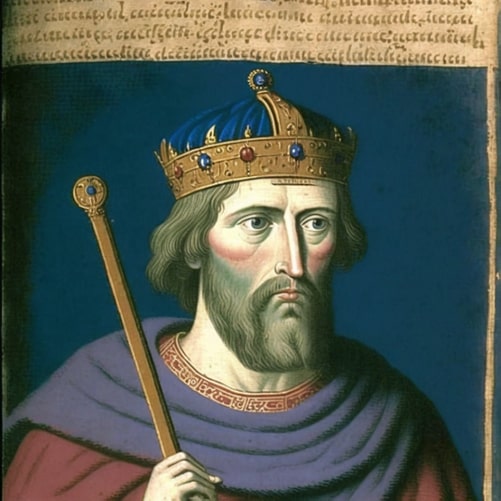
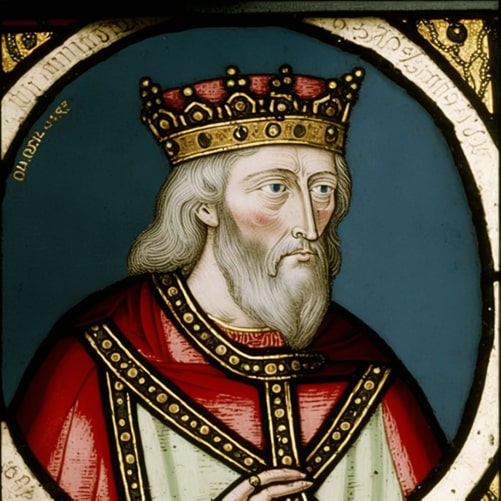
Harthacnut / Harthacanute


Harthacnut / Harthacanute
1040 - 1042 A.D
Delve into Harthacnut's brief but impactful reign, the final phase of Danish rule in England. Confronting dynastic rivalry and inheriting Harold Harefoot's legacy, his stern governance and intensive taxation to support his Danish fleet highlight the era's Norse-Anglo-Saxon dynamics.
Early Life and Background
Born around 1018, Harthacnut was the son of King Cnut the Great and his second wife, Emma of Normandy. Harthacnut spent his early years in Denmark, a crucial period that shaped his identity as a Norse prince. He was heir to his father’s vast North Sea Empire, which included Denmark, Norway, and parts of present-day Sweden.
Ascension to Power
Harthacnut’s ascent to the English throne was delayed due to his commitments in Denmark and the reign of his half-brother, Harold Harefoot, in England. Upon Harold’s death in 1040, Harthacnut was able to claim the English throne. His succession was marked by challenges, including the need to assert his authority and manage the legacy of division left by the previous reign.
Rule and Reign
Harthacnut’s reign, from 1040 to 1042, was characterized by efforts to stabilize a kingdom riven by internal strife and financial burden. One of his most notable and controversial actions was the exhumation and posthumous execution of his half-brother Harold’s body, a symbolic act to solidify his legitimacy. His reign was also marked by heavy taxation to maintain his Danish fleet, an unpopular measure that strained his relationship with his subjects.
Challenges and Conflicts
Harthacnut faced several challenges during his reign, including dissent among the English nobility and a strained treasury. His heavy taxation to support his military expenses was deeply resented, leading to unrest and rebellion. Additionally, his health issues and the lack of a clear heir added to the instability of his rule.
Diplomatic and Cultural Contributions
Harthacnut’s reign did little to contribute significantly to England’s diplomatic and cultural landscape, overshadowed by his administrative and military concerns. However, his rule maintained the Scandinavian influence in England and set the stage for the transition back to native English rule.
Legacy and Succession
Harthacnut’s legacy is mixed, often viewed as a transitional figure between the Danish and native English royal lines. His sudden death in 1042 without an heir led to the ascension of Edward the Confessor, a member of the old Anglo-Saxon royal line, thus ending the Scandinavian dominance in England.
Personal Life
Details of Harthacnut’s personal life are scarce. Known for his physical strength and robust stature, he was also reputed to have indulged in excessive drinking. His sudden death at a wedding feast in 1042, possibly from a stroke, abruptly ended his reign.
King Harthacnut’s biography offers insight into a period of transition in English history, where the last vestiges of Danish rule gave way to the re-establishment of native English kingship. His reign, though brief and fraught with challenges, is a crucial part of the narrative of England’s complex 11th-century monarchy.